Platform comparison
| Platform | YES odds | NO odds | Fee | KYC | Settlement | |
|---|---|---|---|---|---|---|
Polymarket (via Polymarket Qué Es) Pick polygram.ink (preferred broker) |
24% | 76% | 0% (USDC on-chain) | No-KYC up to $1,500 | USDC, auto via UMA oracle | See live odds → |
Polymarket (direct) polymarket.com |
24% | 76% | 0% | Geo-blocked in US/UK/EU | USDC, on-chain | See live odds → |
Kalshi kalshi.com |
— | — | Up to 7% per trade | US-only, KYC required | USD | See live odds → |
Betfair Exchange betfair.com |
— | — | 2-5% commission | Full KYC from first trade | GBP / EUR | See live odds → |
Manifold Markets manifold.markets |
— | — | Play-money (mana) | None — play-money | Mana (no cash-out) | See live odds → |
Outcome probabilities
Current market-implied probability for each outcome, from the live order book.
| Outcome | Probability |
|---|---|
| Somaliland | 24% |
| Qatar | 12% |
| Syria | 12% |
| Turkey | 10% |
| Jordan | 10% |
| Kuwait | 10% |
| Lebanon | 10% |
| Saudi Arabia | 9% |
| Egypt | 8% |
| Azerbaijan | 7% |
| Pakistan | 6% |
| Oman | 5% |
Market context
Polymarket is pricing a **6%** chance that this contract pays out Yes, with traders on USDC collateral and Polygon-based conditional tokens marking up a small probability of a formal Abraham Accords signing before the 2026 cutoff. On the live board, that means the market is treating an actual, publicly acknowledged normalisation deal as a low-probability diplomatic move rather than a base case. [1]
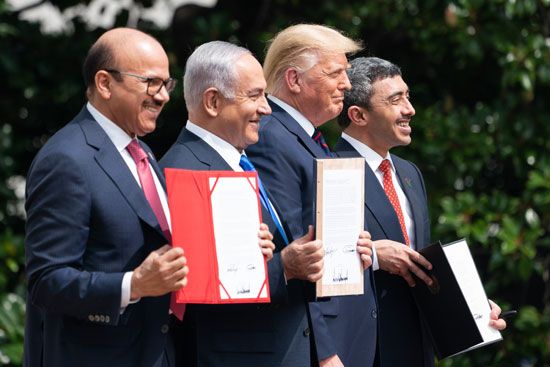
That reading fits the historical record. The Abraham Accords were first signed in 2020 and have so far produced a small set of formal normalisation deals, rather than a broad regional cascade, which is why expansion trades more like a thin tail event than a consensus macro bet. Current reporting and market descriptions point to a handful of named candidates in circulation, but the practical hurdle remains the same: a government-to-government agreement that is explicitly tied to the Abraham Accords framework and completed before the resolution deadline. [3][2]
For traders, the main catalysts are not abstract commentary but hard signals: official joint statements, announced signing dates, and any shift in bilateral ties that moves from talks to a document both sides publicly recognise. Keep an eye on US diplomacy, regional security developments and whether any government schedules a formal announcement rather than only exploratory meetings, because the market resolves on a signed agreement, not on speculation or unfinalised headlines. Polymarket’s own contract page notes that share prices move continuously as traders react to new information, and the payout is binary once the resolution source confirms the event. [1][2]
Methodology
We track Pronóstico: Which country will join Abraham Accords before 2027? across the five venues with material prediction-market liquidity. The probability shown is the live Polymarket mid; the comparison rows summarise how each venue treats the underlying contract — fees, KYC thresholds, settlement currency, deposit options. The highlighted row marks the cheapest route into Polymarket's order book.
Resolution & payout
Settlement runs on-chain. Polymarket's contract logic separates YES and NO shares as conditional tokens; at resolution the winning share lifts to $1.00 and the losing one to $0. The outcome input comes from the UMA Optimistic Oracle, which secures against bad resolution with a bond + dispute window.
Once finalised, the smart contract pays USDC to the holders' wallets within minutes — no withdrawal fees beyond Polygon network gas. Kalshi settles in USD via CFTC clearance, Betfair in account currency net of commission, Manifold in play-money mana with no cash-out.
FAQ
- Where can I trade this market with the lowest fees?
- Polymarket is geo-blocked in the US/UK/EU. The easiest 0%-fee broker into the same order book is Polymarket Qué Es. Kalshi charges up to 7% per trade; Betfair Exchange takes 2-5% commission on net winnings.
- How does resolution work?
- Through the UMA Optimistic Oracle on Polygon: a proposer submits the outcome, a two-hour challenge window opens, and USDC payouts settle automatically once the result is final.
- What's the difference between YES and NO shares?
- A YES share pays $1.00 if the event happens, $0 otherwise. A NO share pays $1.00 if the event doesn't happen. The market price between 0¢ and 100¢ is the implied probability.
- What does Polymarket cost to trade?
- Polymarket itself charges 0% — the only cost is the Polygon network fee, typically under $0.01 per transaction. Off-chain venues like Kalshi or Betfair charge 2-7% commission.
- Do I need to KYC for this market?
- On Polymarket directly, no — it's wallet-based. Intermediary brokers like Polymarket Qué Es trigger KYC only above $1,500 of lifetime trading volume; under that you trade pseudonymously with a single wallet address.
%22%2F%3E%3Cpath%20d%3D%22M%206%2066%20A%2026%2026%200%200%201%2058%2066%22%20fill%3D%22%23E6B98D%22%20opacity%3D%220.9%22%2F%3E%3Ccircle%20cx%3D%2232%22%20cy%3D%2226%22%20r%3D%2222%22%20fill%3D%22%23F5CBA7%22%2F%3E%3Cpolygon%20points%3D%2216%2C18%2020%2C4%2024%2C18%22%20fill%3D%22%2354a9eb%22%2F%3E%3Cpolygon%20points%3D%2224%2C18%2028%2C3%2032%2C18%22%20fill%3D%22%2354a9eb%22%2F%3E%3Cpolygon%20points%3D%2232%2C18%2036%2C3%2040%2C18%22%20fill%3D%22%2354a9eb%22%2F%3E%3Cpolygon%20points%3D%2240%2C18%2044%2C4%2048%2C18%22%20fill%3D%22%2354a9eb%22%2F%3E%3C%2Fsvg%3E) and
and%22%2F%3E%3Cpath%20d%3D%22M%206%2066%20A%2026%2026%200%200%201%2058%2066%22%20fill%3D%22%23E6B98D%22%20opacity%3D%220.9%22%2F%3E%3Ccircle%20cx%3D%2232%22%20cy%3D%2226%22%20r%3D%2222%22%20fill%3D%22%23F5CBA7%22%2F%3E%3Cpolygon%20points%3D%2216%2C18%2020%2C4%2024%2C18%22%20fill%3D%22%2354a9eb%22%2F%3E%3Cpolygon%20points%3D%2224%2C18%2028%2C3%2032%2C18%22%20fill%3D%22%2354a9eb%22%2F%3E%3Cpolygon%20points%3D%2232%2C18%2036%2C3%2040%2C18%22%20fill%3D%22%2354a9eb%22%2F%3E%3Cpolygon%20points%3D%2240%2C18%2044%2C4%2048%2C18%22%20fill%3D%22%2354a9eb%22%2F%3E%3C%2Fsvg%3E)
Trade Pronóstico: Which country will join Abraham Accords … on Polymarket Qué Es
Live order book, 0% fees, USDC settlement in seconds.
Open live market →